
By Sunday Kessig
Absolute Martian Manhunter is a testament to the potential of comics as a medium. Bursting with innovative ideas, it blends notions of superheroes with a modern story about the human mind. It’s worth a read to anyone with a passing interest in comics, or even those curious about what they have to offer.
The first volume, Martian Vision, has just released, collecting issues one through six. It’s a part of DC’s Absolute Universe, which features several new comics that reimagine classic characters under stripped-down, grim circumstances. Their heroes are positioned as deviations in an oppressive establishment, without privileges like Batman’s wealth. The Absolute series has been extremely well-received, and mark a real shift in DC’s focus.
Of the six series announced at the start of the project, Absolute Martian Manhunter was the only limited run, intended to be just half a dozen issues. Less than a week after the first was released, it was confirmed for another six after that. The Martian may not be considered a load-bearing character for the wider DC canon, but he’s proved essential to this new vision for superheroics.
Deniz Camp’s writing blends seamlessly with the art of Javier Rodriguez, two veterans of the industry. Rodriguez is well-known for his work on Daredevil and The Amazing Spider-Man, while Camp has been occupied concurrently with The Ultimates— the tentpole series of Marvel’s equivalent (and precursor) project to the Absolute comics.
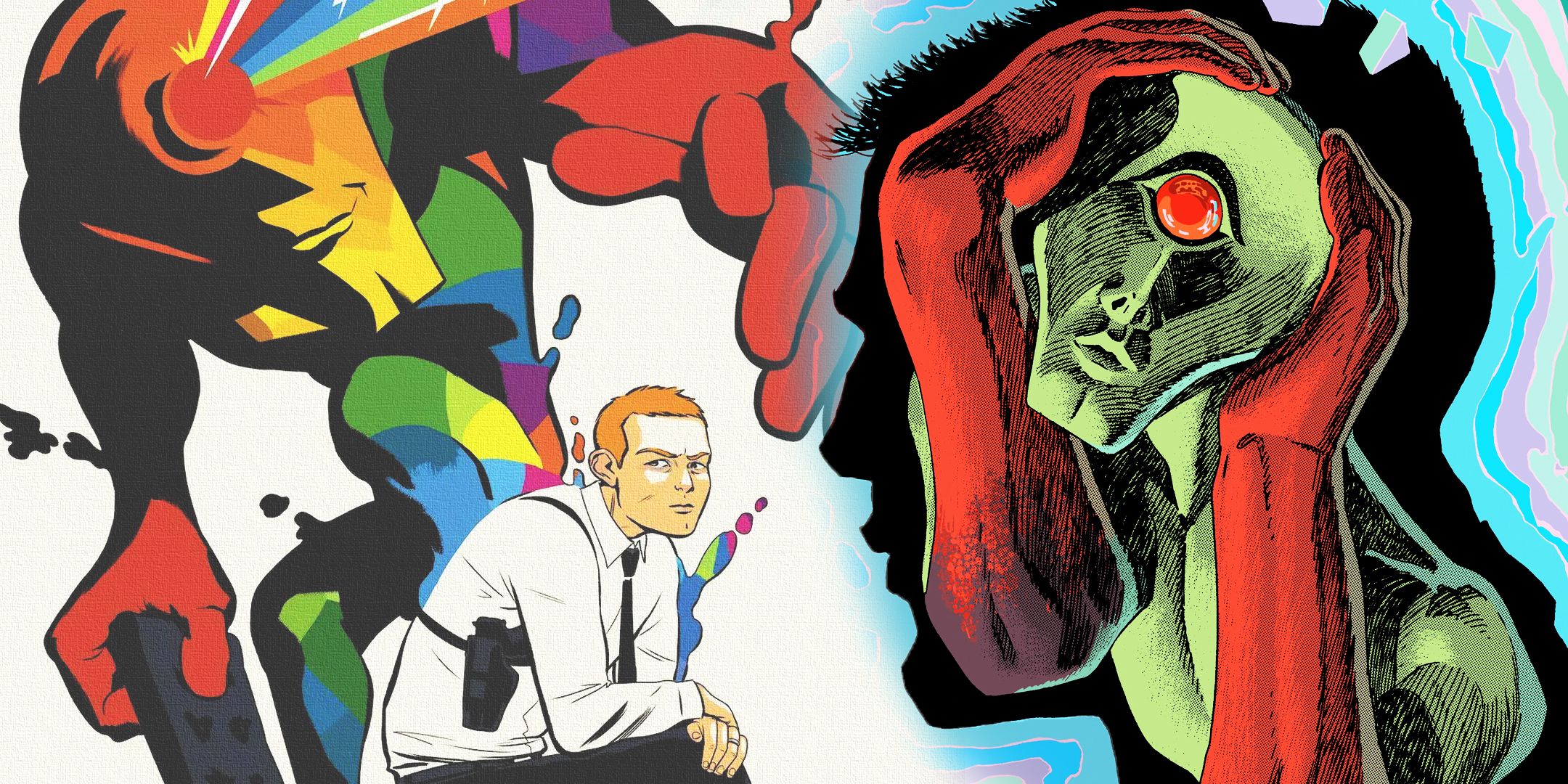
In some cases, it’s nearly indistinguishable where the line is drawn between prose and image, as text changes colour, pours out of bubbles and captions, and even shapes the polychromatic trails of cigarette smoke. The series follows John Jones, an FBI agent, and the large cartoon alien that occupies his brain. After the “Martian” saves Jones from a suicide bombing, they become entangled in a psychic war for the hearts and minds of the city.
Camp describes the series as a “psychedelic noir that tackles the big Human Questions through a small, personal lens.” It deals casually with high concepts and esoteric philosophy, while at once the pages fill with glimpses into the lives of the people John meets. Rodriguez uses colour and some exotic paneling to wrap grounded scenes of city life with mirages of people’s memories and internal monologues.
John struggles to be a good husband and father, while the mercurial Martian stresses the apocalyptic threat of psychic infections, and a god— made of cynicism. John talks down a mass shooter, while the Martian hunts down the delusions in his mind that fuel violent paranoia. The most thrilling moments highlight this contrast. It anchors superheroic stakes to intimate drama in a way that leverages the strengths of both.
At times, the comic’s lofty concepts can become a little hard to follow. The Martian, who serves as the main source of exposition, can only communicate through fractured metaphors and brightly-coloured images. But while this might seem like a downside as a reader, it becomes immersive in a way only comics could provide. As the Martian reaches the sheer limit of what ideas can be shown, so too do the pages explore the full breadth of the medium. Text and images, colours and lines, panels and pages all defy restrictions or limitations. The effort to understand it all places the reader directly in the protagonist’s shoes, as John strains to make sense of what his new partner is trying to say.
As the series continues into its second arc, it maintains this incredible storytelling on the part of the creative team. Each month, new issues demonstrate the potential of the art form. The first volume collects its debut at a discounted price, and is absolutely worth a read.