
By Nicholas Grant
Damien admits that transitioning saved his life. He was 12 years old when he started the process of transitioning from female to male socially and medically. He grew up in a small town, a town he described as bigoted and conservative. Being the only openly trans youth in his elementary school he was bullied relentlessly. Teachers were uninformed and underprepared to support him, his peers bullied him and some of their parents passed on their bigotry.
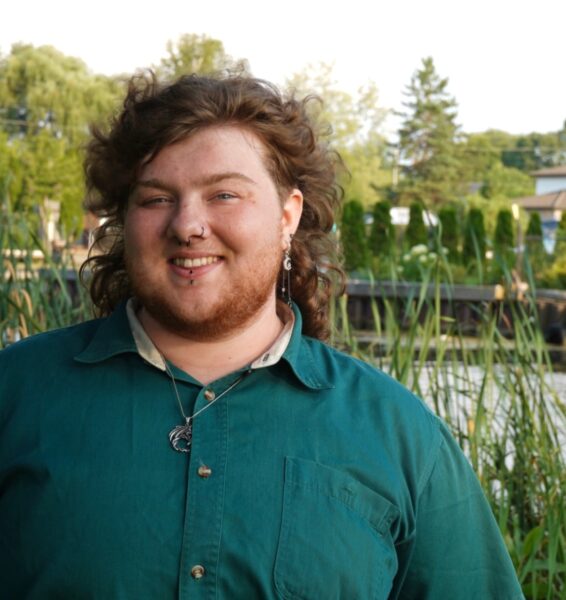
Now Damien is 22 years old, and thriving in a highly competitive musical theatre program at Sheridan College. He’s a gifted singer and actor, and I’m happy to call him one of my best friends. He can often be seen (or heard) merrily singing and dancing around our apartment.
For many trans youth, transitioning isn’t about becoming someone else, it’s about finally being able to live. According to a survey done by the Canadian Medical Association Journal, transgender youth were five times more likely to experience suicidal ideation, and 7.6 times more likely to attempt suicide.
Though we seem so far from the acceptance and understanding we need. There is still hope, and with the right kind of support from the family and community and continued efforts and research from the medical field, transgender youth are more likely to live a happier life according to research done by the CMA
Q: When did you first decide to transition?
Damien: Starting off with a terrible way to word that. First off I am going to say that it is not a decision, being transgender is not something you decide. Research determines that being transgender stems from the development of gender dysphoria. Though this is debated I believe this to be true to define that term; The easiest way to explain it is the disconnect between the mind and the body.
For me I began experiencing gender dysphoria when I was around eight years old. I began feeling disassociated when looking into the mirror, feeling like who I was seeing in the mirror wasn’t a true representation of who I felt like in my mind.
Obviously being at such a young age I didn’t really know how to articulate that, so it presented itself in rejection of femininity, rejection of feminine clothing, rejection of the feminine principles, what it means to be a woman in society and being drawn to more traditionally masculine things and traditionally masculine friendships.
Q: Just to clear something up, I thought transitioning was the blanket or umbrella term for when you start taking testosterone and seeing a doctor about it. What is the actual term for that?
Damien: So that’s a medical transition. However, I would not say that that is the beginning of a person’s transition. The beginning of a person’s transition is generally a social transition, and this doesn’t always happen: but some people choose to socially transition at the same time as they medically transition, but for someone in my case, I was young, so I began transitioning socially prior to transitioning medically.
In my opinion, and in many trans people’s opinions, transitioning doesn’t start when you start medical care; it starts with self acceptance and develops into social transition and in many cases is followed by a medical transition. I will also just make a brief point that not every trans person is going to choose medical care… and that doesn’t make their identity any less valid than someone who does choose the medical field as a support..
Q: You mentioned before that your experiences in elementary and high school were dramatically different, can you tell me a bit more about that?
Damien: High school was very different. I went to a specialty high school for the arts three towns over. Being an art school, it was a lot more progressive, and I was not the first or the only trans person there.
Because I was able to transition so young socially and medically, I was lucky enough to have gone through puberty around the same time as my male peers. So by the time I was in grade nine, I had been socially transitioning and beginning my medical transition thus I was fortunate to have my identity, name and pronouns respected. By most of my peers and faculty I was respected as another high school boy.
Q: What was your parents’ reaction when you told them?, and how has your relationship changed since you’ve told them?
Damien: I was refusing to go to school, crying… having a very emotional outburst. My mom began asking questions… and I came out. I told my mom.
My dad was at work at the time… I was scared of how he would react. I made my mom tell him. He went silent. My dad and I’s relationship did falter very heavily throughout my teen years because of his lack of acceptance. The moment that I walked in the door, he walked out, and that was pretty much how it went for the following month. My mom, on the other hand, did a lot of research and was supportive immediately. And she is to this day my rock. My parents soon after separated due to external reasons and though the relationship with my dad was troubling, over time he made the active decision to grow and learn from his prior ignorance and we now enjoy a close supportive relationship.
Q: What does transitioning feel like internally?
Damien: It is like you look in the mirror again and you say, Oh, that’s where you were. I’ve been looking for you.
Before, it felt like someone used a generative AI to create a picture of you, but it just made it not right. It looks like you, but there is something missing or something wrong. It’s like you look at yourself, and you see the vessel, you see the shell of the human, but you don’t see you in there. Transitioning is like finally letting everything come together.
Q: How has your perspective on life changed since your transition?
Damien: I didn’t think of what my future would look like before I transitioned. I didn’t think I would have a future. I thought I was going to be dead by the time that I was 16, 17, 18. Becoming who I was gave me a new lease on life.
I was able to look into the future. I want to be a husband. I want to be a dad. It’s interesting I say that because I didn’t want to be a wife, and I didn’t want to be a mom. Mother and wife felt wrong but father and husband felt true.
Q: If you can have the readers of this article take one thing away from this story, what would it be?
Damien: You know, I think we all want a perfect world where everyone should be respectful of others. You don’t have to like everyone. You don’t have to agree with everyone. But there should be a level of equality in society. A society where everyone is able to get the necessary things that they need, get the medicine they need, get the help that they need, get the support, the love, the food, the water. Everybody deserves to live. I think, as a society, and whoever may be reading this or seeing this, should face people with curiosity, with openness, with the will to give back. Give someone respect, even if you don’t know them.
I think that we should all collectively give ourselves and give each other grace, and time to learn, while also taking the accountability and time to learn ourselves. New things happen every single day. Yet, transgender people have existed since the dawn of humanity, with plenty of historical evidence to prove it, we are well past the time to accept this fact now we must move forward. There is no reason in which a person can’t make the decision to learn about something different from themselves,however it is no one’s place to tell anyone they are not who they claim to be. Ultimately, there is no reason to hate someone just based on who they are.